As someone with a tech background, I’ve automated everything from my lights to my git push. So naturally, the next logical step was obvious:
Let an AI run my entire financial life. Because what could go wrong?
Spoiler: It didn’t bankrupt me. It actually saved me money – and exposed some embarrassing spending habits I thought I’d buried deeper than my old Bitcoin wallet password.
Week 1: AI Performed a Full Financial Autopsy (And It Hurt)
I uploaded my bank statements expecting a gentle, data‑driven hug. Instead, the AI came back like a forensic accountant with no emotional attachment to my dignity.
It flagged:
- 3 forgotten subscriptions (Apparently, I’ve been funding two different “productivity” apps while still procrastinating like a champion.)
- A duplicate interest charge
- A OneDrive storage plan I haven’t used since 2024
- Suspiciously high weekend spending AI labelled it “behavioural pattern deviation.” I call it “vibes.”
This mirrors what other AI‑finance testers found – AI is brutally good at spotting recurring waste and hidden charges.
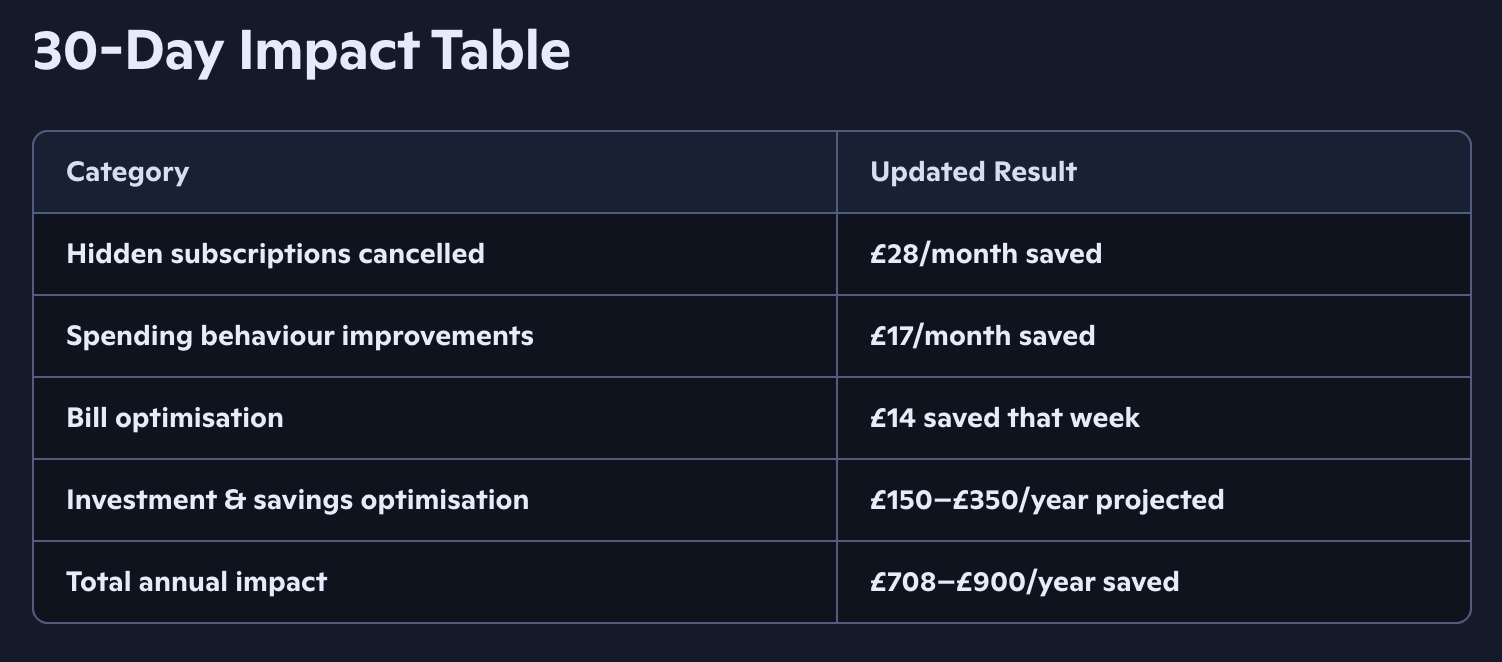
Immediate savings: £28/month. Not bad for a machine that doesn’t even have a bank account.
Week 2: AI Started Cleaning Up My Money Life Automatically
Using tools like Plum or Snoop (or Rocket Money and Cleo in the US), which are known for subscription detection and spending categorisation, the AI suggested:
- Cancelling 3 subscriptions
- Switching to a cheaper mobile plan
- Setting spending alerts for categories where I “show emotional volatility” (Translation: late‑night JustEat or Deliveroo.)
New savings: £17/month.
At this point, the AI was basically the financially responsible friend I never had.
Week 3: AI Took Over My Budgeting & Spending Controls
This is where things got… personal.
Inspired by real experiments where AI predicted overspending patterns, I let it:
- Set weekly spending caps at the pub for pints
- Send real‑time nudges
- Predict when I’d overspend (It nailed it: Fridays and Sundays. Every. Single. Time.)
One alert literally said:
“You’re about to repeat last Sunday’s behaviour. Are you sure?”
I have never felt so judged by a machine.
But it worked, I cut grocery or food‑delivery spending by roughly 38% and saved £14 that week.
Week 4: AI Optimised My Savings & Investments
This part felt like having a junior financial analyst who works for free and doesn’t need coffee breaks.
The AI:
- Moved idle cash into a high‑yield savings account or an ISA Savings
- Suggested a 70/20/10 split for long‑term investing, emergency funds, and short‑term goals
- Flagged ISA optimisation opportunities
- Identified categories where I could reduce spending without lifestyle pain
These behaviours match what other 30‑day AI finance testers reported – AI is surprisingly good at tax‑efficient planning and cash‑flow optimisation.
Projected annual gain: £150–£350.
Practical Tools You Can Use Today (UK + US Versions)
These are the exact tools that replicate what I did during the 30‑day experiment — now tailored for both UK and US readers.
1. Moneyhub (UK)
Open Banking‑powered insights, spending categorisation, and long‑term planning.
2. Emma (UK)
Finds forgotten subscriptions, flags wasteful spending, and gives a clean financial dashboard.
3. Snoop (UK)
AI that scans your transactions and recommends cheaper deals for broadband, mobile, insurance, and utilities.
4. Plum (UK)
Automates savings and investments using behavioural triggers.
5. ChatGPT / Claude for Statement Analysis
Upload a month of statements and ask:
“Identify waste, forgotten subscriptions, spending patterns, and opportunities to save.”
🇺🇸 US Tools
1. Rocket Money (US)
The gold standard for subscription detection and bill negotiation.
2. Monarch Money (US)
Premium budgeting and financial planning with AI‑powered insights.
3. Copilot Money (US)
AI‑driven categorisation and spending analysis with a clean UI.
4. YNAB (US)
Not AI‑powered, but behaviour‑changing and pairs well with AI analysis.
5. Perplexity for Price Comparisons
Great for finding cheaper alternatives for bills and recurring expenses.
🌍 Tools That Work in Both UK & US
ChatGPT / Claude
For analysing statements, building budgets, and generating personalised financial plans.
Notion + AI
For custom dashboards, habit trackers, and automated financial logs.
Google Sheets + AI Plugins
For tech‑savvy users who want to build their own AI‑powered finance system.
What Surprised Me Most
1. AI is brutally honest
It doesn’t sugarcoat. It doesn’t care about your feelings. It just shows you the financial crimes you’ve committed against yourself.
2. AI understands your habits frighteningly well
It predicted my overspending days with the accuracy of a seasoned behavioural economist.
3. AI saves money by removing friction
No spreadsheets. No guilt. Just automated optimisation.
Should You Try This?
If you want to save money without thinking about it, yes. If you’re worried about privacy, start small:
- Upload one month of statements
- Let AI analyse and categorise
- Approve only the changes you’re comfortable with
You’ll still get 80% of the benefit with 0% of the stress.
Disclaimer: This article is for general information only. Always consult a certified accountant for personalised tax advice.
Thank you for reading!
If this story resonated with you, please follow for more practical insights on tech careers, wealth planning, and long-term financial strategy.
You can also read my article about: 💸 The UK’s Hidden 60% Tax Trap: Why Earning £120k Can Leave You Worse Off Than £99k.